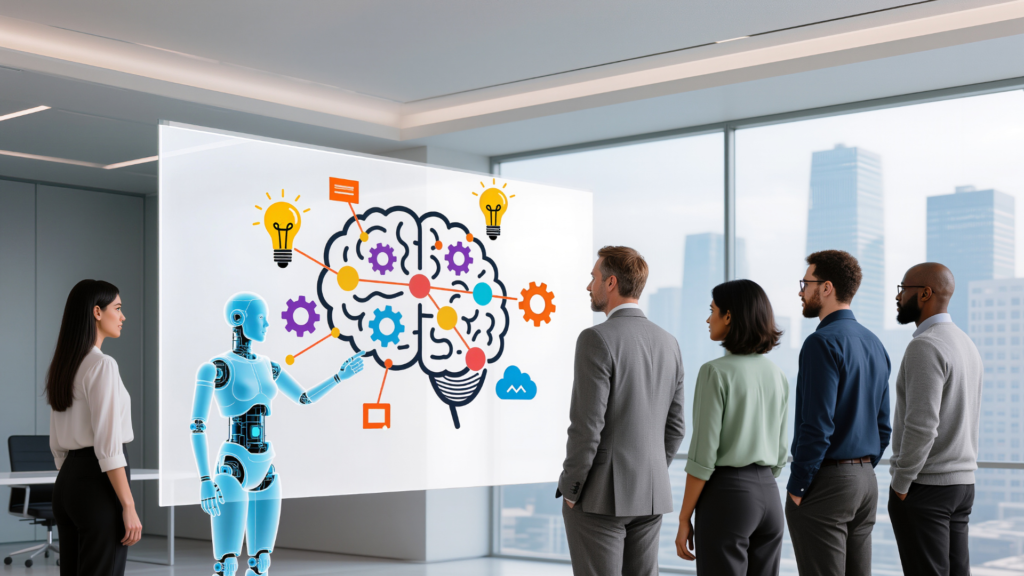
For most people, Artificial Intelligence still feels like a tool.
You open an app.
You ask a question.
You get an answer.
But that model is already becoming outdated.
By 2026, AI will no longer exist as something people use occasionally. Instead, it will become part of smart environments — systems that quietly adapt to human behavior, routines, and needs without constant interaction.
This change will not feel dramatic. It will feel subtle. And that is exactly why it will matter.
From Individual Tools to Intelligent Environments
Today’s AI tools operate in isolation.
One tool writes.
Another edits.
Another analyzes.
Smart environments work differently.
They connect systems together so that AI understands:
Where you are
What you’re doing
What usually comes next
The intelligence shifts from single actions to continuous awareness.
Why Smart Environments Are the Next Step
Humans don’t live in apps.
They live in environments:
Homes
Offices
Public spaces
Digital ecosystems
AI that understands environments can support life more naturally than AI that waits for commands.
This is not about control.
It’s about alignment.
How AI Will Learn Human Patterns
Smart environments rely on patterns, not surveillance.
They observe:
Repeated habits
Timing preferences
Focus cycles
Energy levels
Over time, AI adapts to support these patterns rather than disrupt them.
This makes technology feel cooperative instead of demanding.
Daily Life Inside Smart AI Environments
By 2026, AI-powered environments will:
Adjust schedules dynamically
Reduce unnecessary notifications
Support routines quietly
Prevent small problems before they grow
People won’t interact with AI constantly.
They’ll simply notice that life feels less chaotic.
AI That Anticipates Without Overstepping
Anticipation is useful only when it respects boundaries.
Smart environments will:
Suggest, not decide
Support, not command
Pause when unsure
This restraint will define successful AI systems.
Technology that knows when not to act earns trust.
Workplaces Will Become Adaptive
Future workplaces won’t rely on rigid systems.
AI-driven environments will:
Adjust workloads based on capacity
Reduce unnecessary meetings
Surface only critical information
Instead of managing tools, workers manage thinking and judgment.
This shift toward calmer, more intentional work is something platforms like TechAiNex aim to explain clearly — without exaggeration or fear.
Learning Inside Intelligent Environments
Learning will stop feeling like a separate activity.
Smart environments will:
Reinforce knowledge naturally
Adapt explanations to context
Encourage curiosity without pressure
Education becomes continuous, flexible, and personal.
Creativity Thrives in Adaptive Spaces
Creativity doesn’t need more tools.
It needs fewer obstacles.
AI-driven environments support creativity by:
Removing repetitive tasks
Organizing ideas quietly
Protecting focus
The creative process stays human.
AI stays invisible.
Health and Well-Being Support
Smart environments will support well-being by:
Encouraging healthier routines
Reducing cognitive overload
Supporting consistency
Not through diagnosis.
Not through instructions.
Just gentle environmental support.
Emotional Awareness Without Manipulation
AI environments won’t pretend to feel emotions.
They will recognize patterns:
Stress buildup
Burnout cycles
Focus drops
And respond appropriately — without manipulation or judgment.
This creates healthier relationships with technology.
Trust Is the Foundation of Smart Environments
Invisible intelligence must be trustworthy.
Users will demand:
Transparency
Clear data ownership
Control over autonomy
AI environments that hide behavior will fail — regardless of capability.
Trust is non-negotiable.
Privacy Will Define Adoption Speed
As AI environments become more integrated, privacy concerns increase.
Successful systems will:
Minimize data collection
Offer local processing
Explain decisions clearly
Privacy will be a feature, not a setting.
How Smart Environments Change Human Behavior
When environments adapt intelligently:
People multitask less
Focus improves
Stress decreases
This change happens quietly.
Not because AI forces it — but because friction disappears.
Human Skills That Become More Important
As AI manages structure, humans must focus on:
Ethics
Judgment
Creativity
Emotional intelligence
AI amplifies direction.
Humans provide meaning.
Why This Transition Will Feel Ordinary
The most powerful technologies disappear into daily life.
Electricity.
Internet.
Navigation.
Smart AI environments will follow the same pattern.
One day, people will realize life feels smoother — without knowing exactly why.
Preparing for a Smart Environment Future
You don’t need to learn coding.
Preparation means:
Understanding how AI supports life
Choosing ethical platforms
Maintaining control over decisions
Staying informed
Awareness is enough.
The Quiet Redesign of Human Life
This shift won’t be loud.
It won’t dominate headlines.
But it will reshape:
How people work
How they learn
How they think
Smart environments will quietly redefine modern life.
Final Thoughts
The future of AI is not about smarter machines.
It’s about smarter environments that respect human attention, habits, and values.
By 2026, AI won’t sit on a screen.
It will surround daily life — gently, invisibly, and supportively.
And that’s exactly how real progress happens.