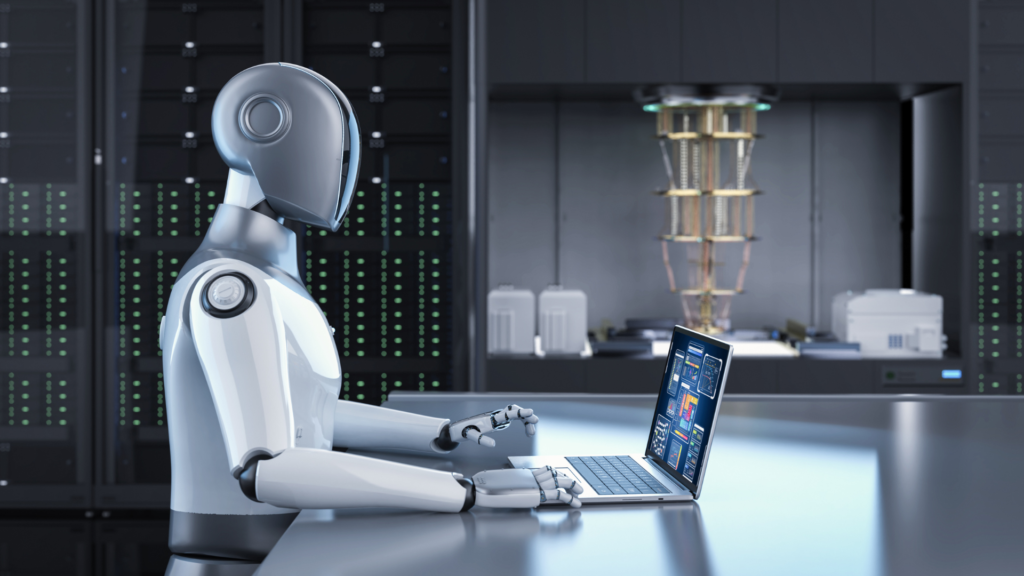
Introduction: When Two Powerful Technologies Collide
Artificial Intelligence is already changing how we live, work, and think.
Quantum computing, on the other hand, still feels like science fiction to many people.
But something important is happening quietly.
AI and quantum computing are starting to merge.
When these two technologies combine, they don’t just improve computers. They redefine what computers are capable of. Problems that once took years to solve could be solved in minutes. Predictions could become far more accurate. Innovation could move at an entirely new speed.
As we move toward 2026 and beyond, the fusion of AI and quantum computing may become the most powerful technological shift of the century.
Understanding Quantum Computing (In Simple Words)
Traditional computers work with bits.
Each bit is either 0 or 1.
Quantum computers work with qubits.
A qubit can be:
0
1
Or both at the same time (superposition)
This allows quantum computers to process massive possibilities simultaneously instead of one at a time.
That single difference changes everything.
Why Classical Computers Are Reaching Their Limits
Even the fastest supercomputers struggle with:
Complex simulations
Large-scale optimization problems
Molecular modeling
Advanced cryptography
As data grows, classical computing slows down.
Quantum computing doesn’t just run faster—it solves different kinds of problems entirely.
This is where AI enters the picture.
Why AI Needs Quantum Computing
Modern AI models depend on:
Huge datasets
Complex mathematical operations
Massive computational power
Training advanced AI systems already consumes enormous energy and time.
Quantum computing can:
Speed up AI training
Improve model accuracy
Reduce computational costs long-term
AI + quantum computing is not about replacement.
It is about amplification.
How AI and Quantum Computing Work Together
Quantum-Enhanced Machine Learning
Quantum algorithms can process high-dimensional data more efficiently.
This means:
Faster pattern recognition
Improved decision-making
More powerful neural networks
Quantum machine learning could outperform traditional AI in complex environments.
Smarter Optimization Problems
AI often solves optimization problems like:
Supply chain planning
Traffic management
Financial modeling
Quantum computing explores millions of solutions at once, helping AI find optimal answers faster.
AI + Quantum Computing in Healthcare
Healthcare is one of the biggest beneficiaries.
Drug Discovery and Medical Research
Quantum computing can simulate molecules at an atomic level.
AI uses these simulations to:
Discover new drugs faster
Reduce trial-and-error
Personalize treatments
What once took 10 years could take months.
Medical Imaging and Diagnostics
AI already assists doctors in diagnosis.
Quantum-enhanced AI could:
Improve image clarity
Detect diseases earlier
Analyze complex medical data instantly
This could redefine preventive healthcare.
AI and Quantum Computing in Finance
Financial markets depend on speed and prediction.
AI + quantum computing helps with:
Risk analysis
Fraud detection
Portfolio optimization
Market simulations
Quantum-powered AI models can analyze countless market scenarios in real time.
Cybersecurity: A Double-Edged Sword
Breaking Encryption
Quantum computers can break many current encryption systems.
This is a risk.
Building Quantum-Safe Security
AI helps design:
Quantum-resistant encryption
Advanced threat detection
Secure communication systems
The same technology that creates risk also creates protection.
AI, Quantum Computing, and Climate Research
Climate systems are extremely complex.
Quantum-powered AI can:
Simulate climate models accurately
Predict extreme weather
Optimize renewable energy systems
This combination could accelerate climate solutions dramatically.
AI + Quantum Computing in Logistics and Manufacturing
Businesses face constant optimization challenges.
Quantum-enhanced AI helps:
Reduce waste
Optimize supply chains
Improve production efficiency
Even small improvements can save millions.
Current Limitations and Challenges
Despite the promise, challenges remain:
Quantum hardware is still fragile
Error correction is complex
High development costs
Limited skilled professionals
But progress is accelerating faster every year.
The Role of AI in Building Better Quantum Systems
AI is not just using quantum computers.
AI is helping build them.
It assists with:
Error detection
Hardware optimization
Quantum circuit design
AI is speeding up the quantum revolution itself.
What Will Change After 2026?
By 2026–2030, we may see:
Hybrid AI-quantum systems
Quantum cloud computing
Commercial quantum applications
New AI models beyond today’s limits
This will reshape industries, research, and innovation.
What This Means for Businesses and Careers
Companies that adapt early will gain huge advantages.
New roles will emerge:
Quantum AI engineers
Hybrid system architects
Advanced data scientists
Learning foundational AI today prepares you for quantum tomorrow.
Ethical and Responsible Development
With great power comes responsibility.
Key concerns include:
Data security
Fair access
Responsible AI usage
Global cooperation
The future must be built thoughtfully.
Final Thoughts: A New Intelligence Era
AI and quantum computing together represent more than technology.
They represent:
A new way of solving problems
A new scale of intelligence
A new future for humanity
The quantum-AI era is not distant.
It is beginning now.